"Eat More Protein" Is the Wrong Answer. Here's Why It Fails Every Woman on a GLP-1.
The standard medical advice for GLP-1 muscle loss has a fatal flaw — and 40% of every pound you lose is paying the price.
You did what they told you to do.
Your doctor said eat more protein. So you ate more protein.
You choked down chicken breasts when you weren't hungry. You forced shakes that sat in your gut like wet cement. You bought the big tub of powder from Costco. Then the other brand. Then the bars. Then the collagen. Then the bone broth.
You hit 100 grams a day. Then 120. Some days 140.
And you still got weaker.
Your arms started looking hollow. Not thin. Hollow. Like something behind the skin had been quietly removed.
Your legs began to shake on stairs. Not every time. Just enough to make you grab the railing. Just enough to make you think about it before you stood up.
Your energy collapsed by early afternoon. Not tired. Drained. The kind of tired that sits behind your eyes and doesn't leave.
You stopped wearing sleeveless tops. Not a decision you made out loud. You just… stopped reaching for them. You caught yourself in the mirror one morning and didn't recognize your own arms.
You told yourself you weren't eating enough. You told yourself you weren't trying hard enough. You told yourself this was just what happens at 48, 52, 55.
But something didn't add up.
Because you were doing the work. You were forcing the food. You were following the advice. And every week, you felt a little less like yourself.
The protein wasn't failing because you were doing it wrong.
The protein was failing because it never had a chance.
Here's What Nobody Explained When You Started Your Medication
Every GLP-1 medication works by slowing your digestion. That's the mechanism. Your stomach empties slower. You eat less. You feel full faster. The weight comes off.
But that same slowdown creates a problem that has nothing to do with willpower or discipline.
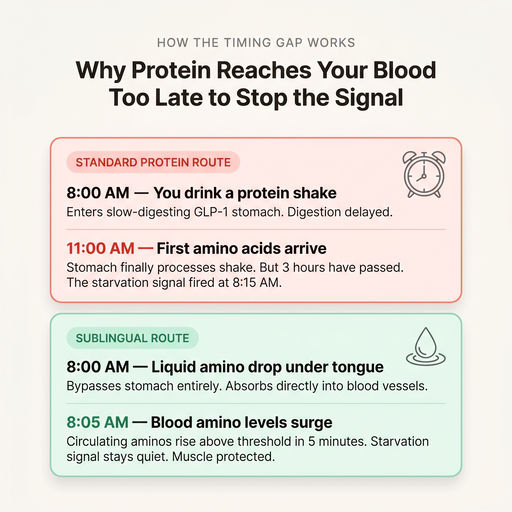
When you eat protein — any protein, from any source — your stomach has to break it down before your body can use it. Normally, that takes about 90 minutes. On a GLP-1, that window stretches to three hours. Sometimes four.
So that protein shake you drank at 8 a.m.? Your body won't see a single amino acid from it until 11. Maybe noon.
But here's the part that changes everything.
Your body doesn't check your stomach to decide whether it's starving.
It checks your blood.
Every few minutes, your body reads the amino acid level circulating in your bloodstream. Think of it as a constant roll call. Are the building blocks there? Are levels high enough to keep critical systems running?
When those levels drop below a specific threshold — and on a GLP-1, they drop fast, because you're eating less and digesting slower — your body fires what researchers call a starvation signal.
This is not a metaphor. It's a measurable biological response.
And your body cannot tell the difference between a medication and a famine. All it knows is that amino acid levels are too low and it needs fuel. Right now. Not in three hours when your stomach finishes processing that shake. Now.
So it goes after the nearest available source of amino acids.
Your muscle.
Not fat. Fat is cheap to store. The body holds onto fat during a perceived famine — that's basic survival biology.
Muscle is expensive. It costs calories just to keep it alive. So the body makes a cold, efficient decision: break the muscle down, harvest the amino acids, use them to keep the heart and brain and organs running.
This happens while your protein is still sitting in your stomach. Undigested. Useless.
By the time those amino acids finally reach your bloodstream, the signal already fired. The damage is already done. The muscle is already gone.
That's the gap. Three to four hours of delay on one side. A signal that fires in minutes on the other.
And no amount of chicken or protein powder can close it.
"Women who were forcing 130, 140 grams a day lost muscle at the same rate as women eating far less. The protein intake didn't matter. The timing gap made it irrelevant."
The body wasn't starving for lack of protein in the diet. It was starving for lack of amino acids in the blood. And on a GLP-1, those are two completely different things.
This is why the standard advice fails. "Eat more protein" treats it as a nutrition problem. It's not. It's a delivery problem. The protein is there. It just can't arrive fast enough.
Once You See It This Way, the Question Changes
It's no longer "how much protein should I eat?" It's "how do I get amino acids into my blood before the signal fires?"
Think of your body's amino acid monitoring system as a fuel gauge.
The gauge doesn't care what's in the tank. It doesn't care what you ate, how much you ate, or how high-quality your protein source was. It only reads one thing: what's in the blood, right now, at this moment.
Your Body's "Fuel Gauge" — What It Actually Reads
On a GLP-1, the fuel gauge drops fast. You're eating less. What you do eat sits in your stomach for hours. The gauge keeps falling.
When it hits empty, the signal fires. Muscle burns.
So the only thing that matters is getting the gauge back above the line before the signal goes off.
And anything that has to pass through your stomach first — shakes, chicken, bars, powders, eggs, collagen — is subject to the same three-to-four-hour delay.
It doesn't matter how expensive the protein is. It doesn't matter how clean the sourcing is. If it goes through the stomach, it's too slow.
The stomach is the bottleneck. On a GLP-1, it's a bottleneck that can't be forced open.
So what bypasses the stomach entirely?
The Fastest Absorption Route in the Human Body
The tissue under your tongue is one of the thinnest membranes in your body. It's packed with blood vessels sitting just below the surface.
When a substance is placed under the tongue — what pharmacology calls sublingual delivery — it doesn't travel to the stomach. It absorbs directly through that tissue, straight into the bloodstream.
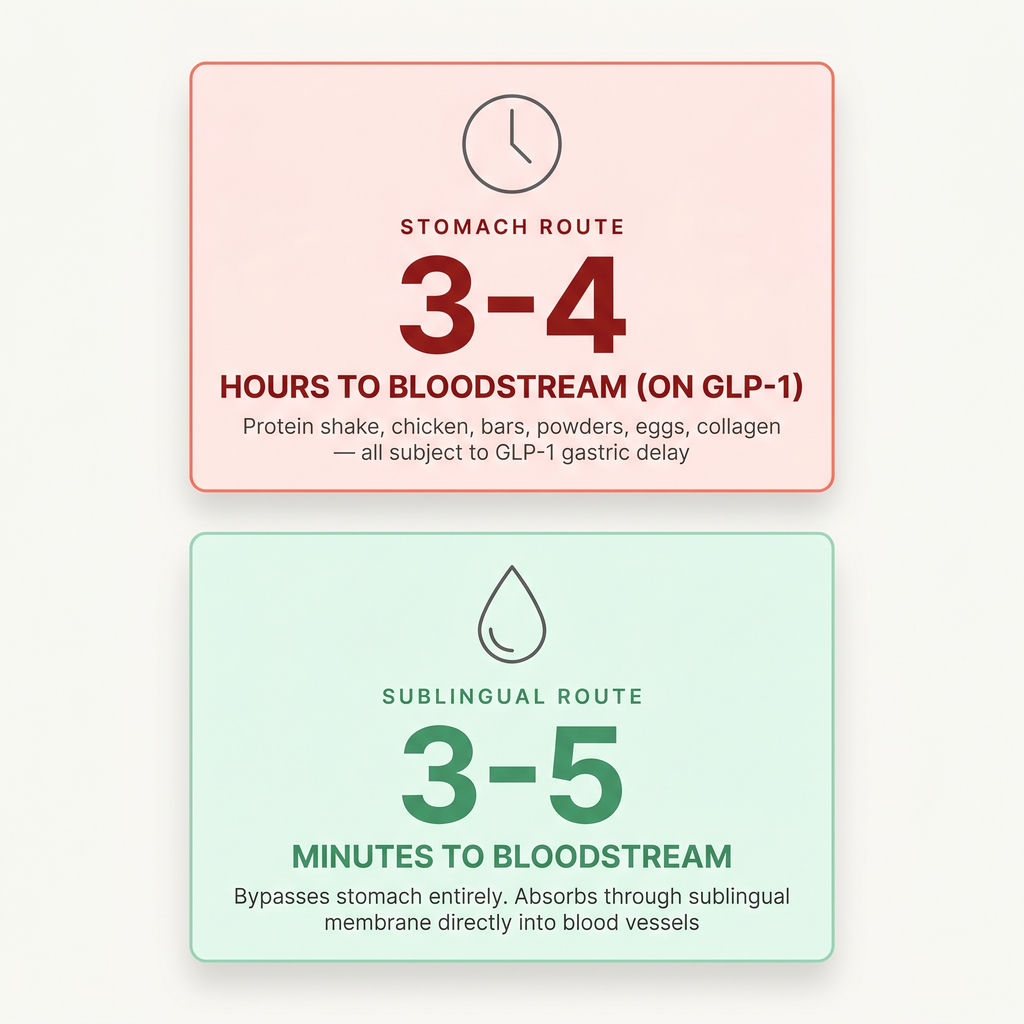
A 2012 review published in the Journal of Pharmacy & BioAllied Sciences confirmed that sublingual compounds can reach the bloodstream in as little as three to five minutes — compared to 30 minutes or more through the stomach under normal digestion. On a GLP-1, that stomach window stretches to hours. It's the same fast-absorbing route the body relies on when speed matters most.
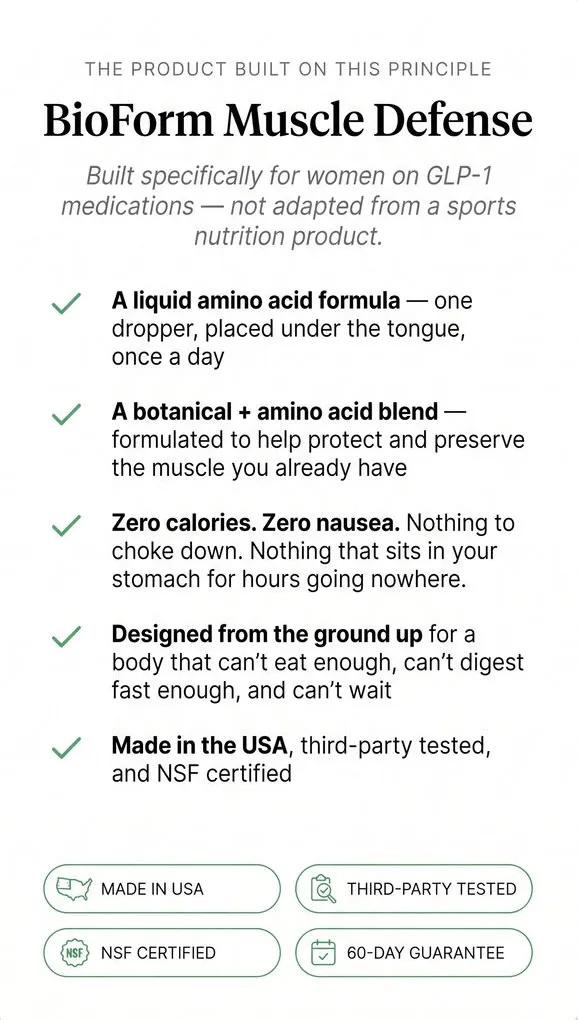
BioForm calls this their Rapid Signal Defense™ system. The principle is mechanical, not magical: deliver amino acids directly to the blood through the fastest absorption route in the body — before the starvation signal has a chance to fire.
Blood amino acid levels rise above the threshold in minutes. The fuel gauge reads full. The signal stays quiet. The body goes back to burning fat. The muscle stays exactly where it is.
This isn't about eating more. It's about changing the route.
Here's What Changes — and How Fast It Changes
The first thing most women notice is the energy. Not a caffeine spike. A return. Like a fog you didn't know was there quietly lifts sometime in the first week. You get to 2 p.m. and realize you're not gripping the couch, bargaining with yourself to stay upright. You're just… fine. Functioning. The way you used to before the medication started draining you.
Sleep tends to follow. Women who'd been waking at 3 a.m. for months — eyes open, mind racing, body buzzing with a low-grade exhaustion that rest can't touch — start sleeping through the night. Not because Muscle Defense is a sleep aid. Because when your body stops cannibalizing muscle tissue overnight, it stops waking you up to do it.
Then the physical changes start becoming visible.
The hollowness in your arms begins to fill back in. Not bulk. Shape. Definition. The difference between an arm that looks like it belongs to you and one that looks like it's been slowly emptied from the inside.
Your legs stop shaking on the stairs. Not gradually. There's a day — usually somewhere around week two or three — where you walk up a flight and realize halfway up that you didn't reach for the railing. You didn't hesitate. You just walked.